
Habitats
/prod01/channel_2/media/uniofsuffolk/website/content-assets/images/sustainability/Wellbeing-allotment-(2)-Date-and-photographer-unknown.jpg)
Here you will find information on our approach to habitats creation, monitoring and promotion on an urban campus, key objectives, alignment to the UN SDGs, the different habitats on campus, case studies, and latest progress. Where possible, we try to plant native species only. If you have an idea, please contact sustainability@uos.ac.uk.
Several areas are Living Labs, spaces that form longitudinal research pieces to inform best practices to urban habitat management.
- Enhance habitat biodiversity on the estates which the University manages
- Ensure compliance with all relevant environmental legislation and regulations
- Ensure that sustainability and biodiversity opportunities are identified and implemented when considering land use, development, and construction
- Protection of the environment, including prevention of pollution
Effective habitat management is both great for wildlife and humans, but also equally importantly, contributes directly to several UN Sustainable Development Goals, including:
Located in the heart of Ipswich and close to nationally important landscapes such as the Stour and Orwell Estuaries, which support rare species, nature recovery and essential ecosystem services, from flood mitigation to improved air quality, while delivering significant mental and physical wellbeing benefits.
Our principal aim is to develop a climate-resilient, biodiverse campus that supports education, wellbeing, and community engagement. By strengthening green infrastructure, protecting priority habitats, and embedding sustainability across research, teaching, and operations, the University is positioning itself as a leader in urban ecological innovation.
Rather than concentrating on individual species, the 2025 to 2030 Habitat Plan and associated Action Plan focuses on the wider ecosystems that sustain everything from pollinating insects and nesting birds to the students and staff who use our campus every day. We always aim to plant only native species.
The Habitat Plan and supporting Habitat Action Plan provide a clear and practical roadmap to 2030, ensuring activities remain coordinated, measurable, and continuously improving.
-
Caring for existing habitats
Ongoing monitoring, specialist input, and evidence-led management ensure our established habitats remain healthy and resilient.
-
Enhancing and Expanding Green Infrastructure
All development and maintenance activities consider opportunities to enhance biodiversity through wildlife-friendly landscaping, green roofs, and connected ecological corridors.
-
Encouraging Participation and Engagement
Through Living Labs, teaching, volunteering, and community partnerships, habitats are used as active spaces for learning, research, and wellbeing.
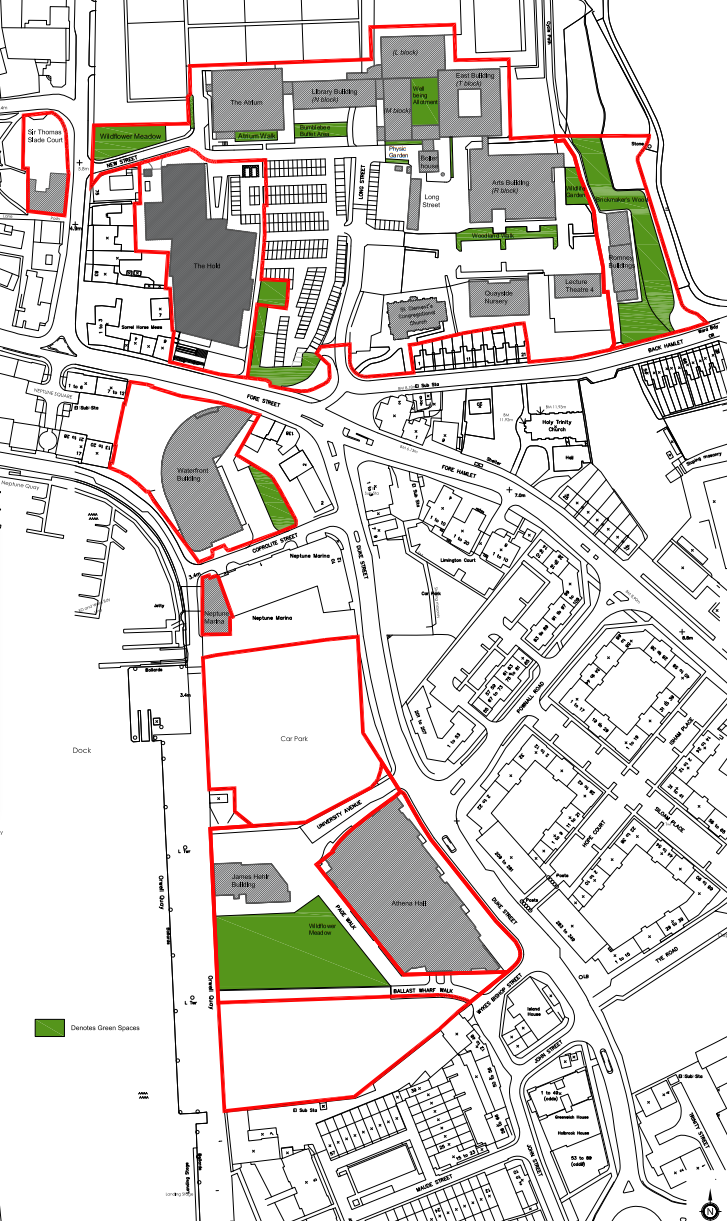
In recent years, we have developed a range of diverse habitats, each offering distinct ecological and educational value, including wildflower meadows, a Bumblebee Buffet Area, a Wellbeing Allotment for students and staff and many others. Many are Living Labs. Case studies and more information below.
Wildflower Meadow
We have two wildflower meadows on campus - one at the back of our James Hehir Building, and one near our Atrium Building. The latter is our biggest habitat at 1,131 square meters in area, and last year's habitat survey showed it was home to 22 species!
-Date-and-Photographer-unknown.jpg)
Wellbeing Allotment
Officially opened in 2024, the Wellbeing Allotment is a peaceful and productive space for growing food, developing new skills, and taking restorative breaks from busy schedules. Students and staff can use it at any time, and since 2024, monthly volunteering sessions have been promoted, including with the Student Union. The allotment has successfully engaged both staff and students in practical sustainability activities while serving as an active living laboratory. Over 50kg of food has been grown since its opening, and any surplus food is provided to the Student Union Food Bank.
Latest updates can be found on our News and Events page.
-May-2025-Will-Green-Photography-reduced.jpg)
These spaces enhance our role as a civic university by enabling us to support local organisations, build community partnerships, and share knowledge and skills across Ipswich.
We are committed to meeting, and where possible exceeding, biodiversity legislation and best practice, including biodiversity net gain requirements. The Habitat Plan 2025–2030 sets out the actions that will guide habitat creation, maintenance, monitoring, and engagement, ensuring long‑term positive impact.
For more information, see our Habitat Plan 2025 to 2030 and Habitat Action Plan.
- Woodland Walk creation part 1: One student helped us begin the planting of the Woodland Walk, a brand new 200m2 area of habitat, and a brand new Living Lab.
- University’s Welcome Week fair, the Sustainability Team made pumpkin cake out of a 12kg pumpkin grown in our Wellbeing Allotment. This event saw engagement from 100 students and staff; we discussed all aspects of sustainability.
- Dogwood coppicing and dead-hedge creation: in partnership with Suffolk Wildlife Trust, 5 students joined the Sustainability Team in our Wildlife Garden to coppice dogwood (exposing the pond with more light) and created a dead hedge out of it, providing value to wildlife.
- Planting of trees with Marketing, Comms and International Directorate: Five staff members joined up to plant 20 trees donated from the Woodland Trust, including rowan, crab apple and hazel. These were planted in our Atrium Walk and Woodland Walk.
- Earth Day 2026: A tour around our habitat spaces, with two students and eight members of the public seeing what we’re doing.
- Woodland Walk creation: Some initial planting was done with students and staff and then in partnership with Suffolk Wildlife Trust, eight students joined us to plant the remaining species.
Continued progress was made in enhancing biodiversity and green spaces across the University estate; key highlights include:
- Launching of the University’s Habitats Plan, providing a clear framework for habitat enhancement and monitoring through to 2030.
- Ongoing development of new habitat spaces, supporting biodiversity while delivering wellbeing and educational benefits.
- Habitat surveys undertaken using the UK Habitat Classification methodology, with support from academic staff, and students.
Habitat Performance 2024/25
- Bumblebee Buffet Area: 28 species recorded, an increase of 11 species year‑on‑year, demonstrating sustained habitat improvements
- Wildflower Meadow: 22 species recorded; management approaches are under review to respond to hotter, drier conditions
- Wellbeing Allotment: Continued success, with increased promotion of volunteering sessions to support engagement and community wellbeing
For further detail, please refer to the 2024-2025 Sustainability Report.
Explore our habitat spaces
These images showcase our habitats and the variety of habitats we have on site, including:
- Wildflower meadows support a wide range of pollinators (A Living Lab)
- A physic garden which demonstrates native plants that have had/ are used for medicinal purposes, and which are great for biodiversity. The planting is organised specifically to show the evolution of plants used for medicinal purposes over time.
- A Bumblebee Buffet Area, including a heritage orchard made up of seven Suffolk-based fruit trees! (A Living Lab)
- A Wildlife Garden with a freshwater pond located on a former spoil heap, with over 79 different species recorded in 2023 (A Living Lab)
- Wellbeing Allotment for students and staff
- A brand new Woodland Walk area created from October 2025 to April 2026, with support from the Annual Fund pot (A Living Lab)
- Blub land: a former spoil heap turned into an oasis of bulbs, including native daffodils, crocuses, and snowdrops (A Living Lab)
- Brickmakers Wood (A Living Lab)
/prod01/channel_2/media/uniofsuffolk/website/content-assets/images/sustainability/Wellbeing-allotment-(2)-Date-and-photographer-unknown.jpg)
/prod01/channel_2/media/uniofsuffolk/website/content-assets/images/sustainability/Wellbeing-allotment-(20)-June-2024-Jason-Noble.jpg)
/prod01/channel_2/media/uniofsuffolk/website/content-assets/images/sustainability/Garden-(3)-Date-and-Photographer-unknown.jpg)
/prod01/channel_2/media/uniofsuffolk/website/content-assets/images/sustainability/Garden-pond-biodiversity-board-(1)-July-2024-Jason-Noble.jpeg)
/prod01/channel_2/media/uniofsuffolk/website/content-assets/images/sustainability/Staff-planting-trees---Bumblebee-Buffet-Area---taken-by-Thomas-Heathwaite.jpg)
/prod01/channel_2/media/uniofsuffolk/website/content-assets/images/sustainability/Wildflower-meadow-(31)-Date-and-Photographer-unknown.jpg)
/prod01/channel_2/media/uniofsuffolk/website/content-assets/images/sustainability/Bumblebee-buffet-biodiversity-board-(1)-May-2025-Will-Green-Photography.jpg)
/prod01/channel_2/media/uniofsuffolk/website/content-assets/images/sustainability/Green-roof-bike-shelter-(5)-Date-and-Photographer-unknown.jpg)
/prod01/channel_2/media/uniofsuffolk/website/content-assets/images/sustainability/Green-roof-bike-shelter-(1)-Date-and-Photographer-unknown.jpg)
/prod01/channel_2/media/uniofsuffolk/website/content-assets/images/sustainability/Winter-Aconite-Woodland-Walk---taken-by-Thomas-Heathwaite-(2).jpg)
/prod01/channel_2/media/uniofsuffolk/website/content-assets/images/sustainability/Blubs---near-library-bridge---taken-by-Thomas-Heathwaite-(4).jpg)
/prod01/channel_2/media/uniofsuffolk/website/content-assets/images/sustainability/Blubs---near-library-bridge---taken-by-Thomas-Heathwaite-(6).jpg)
Related Documents
/prod01/channel_2/media/uniofsuffolk/website/content-assets/images/sustainability/Blubs---near-library-bridge---taken-by-Thomas-Heathwaite-(2).jpg)
Explore our Habitat Plan 2025-2030 and see what we are aiming to achieve over the next five years
/prod01/channel_2/media/uniofsuffolk/website/content-assets/images/sustainability/Wellbeing-allotment-(10)-June-2024-Jason-Noble.jpg)
The Habitat Action Plan helps us guide the University towards the Habitat Plan's vision, implementing its aims and philosophy through a dynamic, evolving roadmap that is updated annually.
/prod01/channel_2/media/uniofsuffolk/website/content-assets/images/sustainability/Car-charging-point-(7)-Date-and-Photographer-unknown.jpg)
This document summarises what the Sustainability Team achieved during the 2024 to 2025 reporting year, including the attainment of Eco Campus Silver, the launching of the Habitat Plan and Action Plan, and other developments across our key themes.
/prod01/channel_2/media/uniofsuffolk/website/content-assets/images/sustainability/badges/Eco-Campus-Silver-Award-Logo.jpg)
Our infographic shows at a glance the key achievements from the 2024/25 annual report.